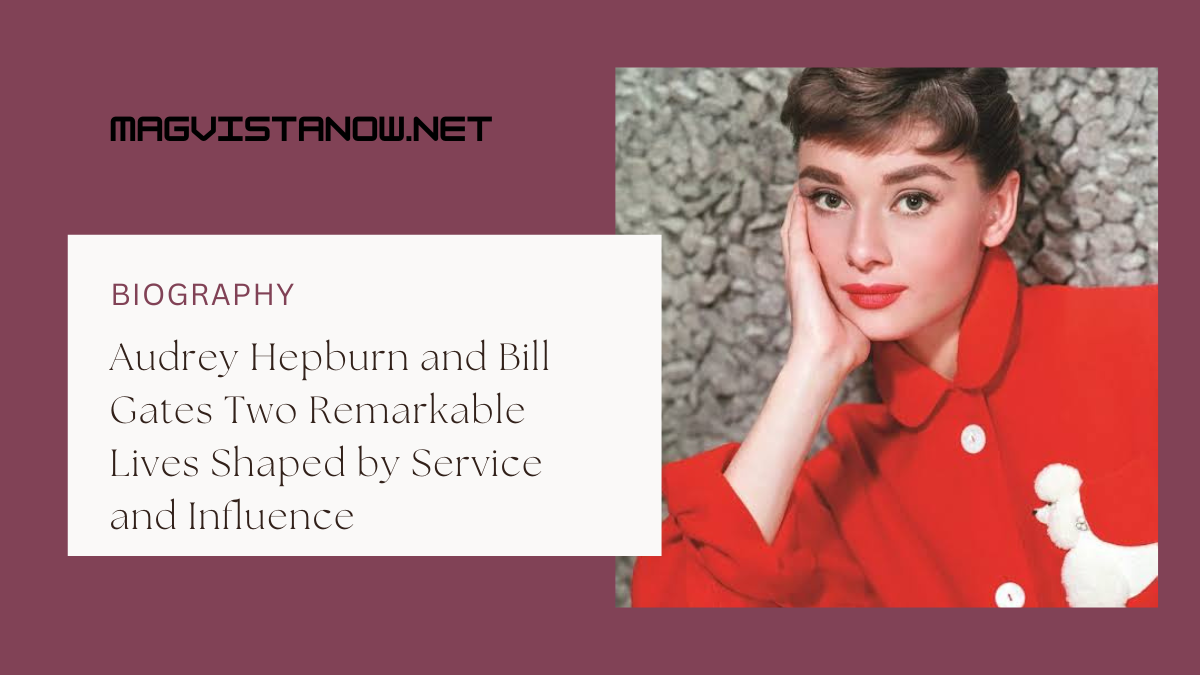
Audrey Hepburn and Bill Gates Two Remarkable Lives Shaped by Service and Influence
Sometimes the most fascinating connections are not between people who worked together, but between people who left a similar mark on the world in completely different ways. The stories of Audrey Hepburn and Bill Gates are a striking example. One became an international film icon whose elegance defined an era; the other helped transform personal computing and later became one of the world’s most prominent philanthropists. They belonged to different generations and very different professional worlds, yet both eventually became deeply associated with humanitarian causes.
Hepburn’s later life was especially devoted to children affected by poverty, hunger, disease, and displacement. Audrey Hepburn and Bill Gates As a UNICEF Goodwill Ambassador from 1988 until her death in 1993, she travelled extensively, spoke publicly about children’s rights, and used her fame to draw attention to humanitarian emergencies. Gates, meanwhile, moved from leading Microsoft to concentrating on philanthropy, supporting large-scale efforts in global health, poverty reduction, education, and scientific innovation.
Although there is no major documented partnership between the two, comparing their lives reveals something meaningful: influence can take many forms, Audrey Hepburn and Bill Gates and fame or wealth becomes particularly powerful when it is directed toward causes larger than oneself.
Quick Overview
| Topic | Audrey Hepburn | Bill Gates |
|---|---|---|
| Born | May 4, 1929 | October 28, 1955 |
| Known for | Acting, fashion, humanitarian work | Technology, Microsoft, philanthropy |
| Major career field | Film and entertainment | Technology and business |
| Humanitarian focus | Children’s rights and welfare | Global health, poverty, education, innovation |
| Major organization | UNICEF | Gates Foundation |
| Public legacy | Cinema and humanitarian advocacy | Technology and large-scale philanthropy |
| Major transition | From actress to humanitarian advocate | From Microsoft leader to full-time philanthropist |
Two Very Different Paths to Global Influence
At first glance, Hepburn and Gates could hardly seem more different. Hepburn rose to international fame through cinema, while Gates became famous through software and entrepreneurship. Audrey Hepburn and Bill Gates Their careers were separated by decades, and their professional environments had almost nothing in common.
Yet both understood the power of visibility. Hepburn could attract worldwide attention simply by appearing at a humanitarian event, while Gates could mobilize enormous financial resources and scientific partnerships. Audrey Hepburn and Bill Gates Their methods differed, but the underlying idea was remarkably similar: influence could be used to bring attention and resources to problems that might otherwise remain overlooked.
That distinction matters when discussing their legacies. Audrey Hepburn and Bill Gates Neither person’s humanitarian contribution can be reduced simply to fame or money. Hepburn’s greatest asset was her ability to make distant humanitarian crises emotionally visible to millions of people, while Gates’s philanthropic approach has emphasized research, measurable outcomes, partnerships, and scalable solutions.

Audrey Hepburn’s Early Life and Rise to Fame
Audrey Hepburn was born in Brussels, Belgium, in 1929. Her childhood was profoundly affected by the Second World War, including experiences of hardship and food shortages. UNICEF later became particularly meaningful to her because she remembered receiving food and medical assistance after the war.
Her early ambition was ballet, but her career eventually moved toward acting. A role connected to the stage production of Gigi helped establish her internationally, followed by her breakthrough film role in Roman Holiday. She went on to become one of the most recognizable actresses of the twentieth century.
Her screen career made her famous, but her later work gave that fame a different purpose. Audrey Hepburn and Bill Gates By the late 1960s, she had largely stepped away from acting to focus on family life, returning only occasionally to the screen before devoting much of her final years to humanitarian work.
Bill Gates and the Rise of Personal Computing
Bill Gates followed an entirely different route. Born in Seattle in 1955, he developed an early interest in computers and eventually co-founded Microsoft with Paul Allen in 1975. Audrey Hepburn and Bill Gates The company became a major force in personal computer software, helping make Gates one of the most recognizable figures in the technology industry.
His business career also created enormous financial resources, which later became central to his philanthropic work. Audrey Hepburn and Bill Gates Rather than remaining focused exclusively on technology, Gates increasingly turned his attention toward global health, development, education, and scientific research.
In 2008, he transitioned to working full-time on the foundation’s efforts. His role today includes shaping and approving foundation strategies and advocating for issues connected to health, poverty, and equality.
Audrey Hepburn and Bill Gates: A Shared Humanitarian Spirit
The most interesting comparison between Hepburn and Gates is not a supposed personal relationship. There is no substantial evidence that they were close collaborators or that they built a major joint project. Their connection is better understood as a comparison of two influential people who eventually directed much of their public influence toward humanitarian causes.
Hepburn worked primarily through advocacy and personal presence. Gates has generally worked through philanthropy, scientific investment, institutional partnerships, and long-term programs.
Hepburn’s Work With UNICEF
Hepburn became a UNICEF Goodwill Ambassador in 1988. Her first official mission took her to Ethiopia, where drought and conflict had contributed to severe suffering among children and families. Audrey Hepburn and Bill Gates She then continued travelling to countries including Turkey, Venezuela, Ecuador, Guatemala, Honduras, Bangladesh, Thailand, Vietnam, Sudan, and others.
Her role was not simply ceremonial. She participated in interviews, speeches, fundraising activities, field visits, and international events. She also addressed political leaders and helped bring public attention to children’s rights and humanitarian emergencies.
One particularly striking aspect of her advocacy was her willingness to see difficult conditions firsthand. Audrey Hepburn and Bill Gates Rather than speaking only from a studio or formal event, she travelled to communities where UNICEF programs were operating. Her experiences gave greater personal weight to the message she delivered to audiences around the world.
UNICEF’s historical archives also record Hepburn’s involvement in children’s rights initiatives, including a design she created for a United Nations postal issue related to the rights of the child.
Gates’s Approach to Philanthropy
Bill Gates’s philanthropic career developed on a much larger institutional scale. The Gates Foundation was established in 2000 and has focused on reducing disease and poverty while improving opportunities for people around the world. Its work includes global health, maternal and child health, infectious diseases, economic opportunity, and other areas.
A defining feature of the foundation’s approach is its emphasis on innovation and evidence. Instead of relying only on traditional charitable giving, it supports researchers, governments, nonprofits, community organizations, and other partners working on complex problems.
The scale is substantial. According to the foundation’s current figures, it provided $8.5 billion in charitable support during 2025, while total charitable distributions since its inception reached more than $110 billion through the end of that year.
This makes Gates’s philanthropic model very different from Hepburn’s. Hepburn could walk into a room and immediately capture attention; Gates could help fund laboratories, health programs, vaccines, researchers, and international partnerships. Audrey Hepburn and Bill Gates One operated primarily through public advocacy, while the other has operated through institutional resources and long-term investment.
How Their Legacies Continue
The impact of both figures extends well beyond the period in which they were most famous.
Hepburn died on January 20, 1993, but her humanitarian reputation remains closely associated with UNICEF. The organization continues to recognize her as one of its legacy ambassadors, and her work is remembered as an example of how a celebrity can use public recognition to advocate for vulnerable children.
Her legacy is also unusual because her humanitarian identity eventually became almost as significant as her film career. Many people first encounter Hepburn through photographs, films, or fashion history, yet her UNICEF work offers a different understanding of the person behind the famous image.
Gates’s philanthropic legacy is still developing. The Gates Foundation announced in 2025 that it would close permanently at the end of 2045, with Gates planning to direct virtually all of his remaining wealth toward the foundation during that period. Audrey Hepburn and Bill Gates The stated priorities include ending infectious diseases, preventing deaths among mothers and babies, and helping people escape poverty.
That decision gives the foundation’s future work a defined time horizon. Audrey Hepburn and Bill Gates Rather than existing indefinitely, it is designed to concentrate resources and accelerate progress during its remaining years.
What Their Stories Teach Us
The comparison between these two figures offers several useful lessons.
- Influence does not have a single form. Hepburn used celebrity and communication, while Gates used technology, wealth, research, and institutions.
- Personal experiences can shape public service. Hepburn’s memories of wartime deprivation helped influence her connection to UNICEF, Audrey Hepburn and Bill Gates while Gates’s exposure to global health problems helped redirect his attention toward philanthropy.
- Lasting impact requires more than recognition. Both eventually became associated with work that extended beyond their original careers.
Their stories also demonstrate that humanitarian work does not have to look identical to be meaningful. Audrey Hepburn and Bill Gates A famous actor standing before cameras and a technology entrepreneur supporting international research may appear worlds apart, but both can contribute to the same broad goal of improving human lives.
The Importance of Children’s Welfare in Both Stories
Children occupy a particularly important place in Hepburn’s humanitarian legacy. UNICEF’s work became the central public cause of her final years, Audrey Hepburn and Bill Gates and she repeatedly spoke about the needs of children affected by poverty, disease, hunger, and conflict.
Gates’s philanthropic work has also placed children and families near the center of several major initiatives. The Gates Foundation currently identifies maternal, newborn, Audrey Hepburn and Bill Gates and child health as one of its major priorities, alongside infectious diseases and poverty reduction.
The methods remain different, but the common theme is clear. Improving children’s health and opportunities can affect entire communities because healthier children are more likely to survive, learn, develop, and eventually contribute to their societies.
Did They Ever Work Together?
One question naturally appears whenever these two names are mentioned together: did Audrey Hepburn and Bill Gates actually work together?
There is no well-established record of a major collaboration between them. Their careers largely belonged to different periods, and Hepburn died in 1993, when Gates was still primarily known as Microsoft’s leader rather than the global philanthropist he later became.
The more meaningful connection is therefore thematic rather than personal. Both became internationally recognized figures who used their public influence in ways that extended beyond their original professions.
Frequently Asked Questions
1. Who was Audrey Hepburn?
Audrey Hepburn was a Belgian-born actress who became one of the most celebrated stars of twentieth-century cinema. Later in life, she devoted significant energy to humanitarian advocacy as a UNICEF Goodwill Ambassador from 1988 until her death in 1993.
2. Who is Bill Gates?
Bill Gates is an American technology entrepreneur and philanthropist best known for co-founding Microsoft with Paul Allen in 1975. He later shifted much of his attention toward philanthropy and continues to serve as chair and a board member of the Gates Foundation.
3. Did Audrey Hepburn and Bill Gates know each other?
There is no strong public evidence establishing a significant personal relationship or major collaboration between them. Their apparent connection is primarily based on their shared association with humanitarian work.
4. What was Audrey Hepburn’s role at UNICEF?
Hepburn served as a UNICEF Goodwill Ambassador from 1988 to 1993. She travelled to humanitarian missions, met children and families, spoke with journalists and political leaders, and advocated for greater attention to children’s needs.
5. What does the Gates Foundation focus on?
The Gates Foundation works to reduce disease and poverty and expand opportunities for people worldwide. Its current priorities include infectious diseases, maternal and child health, economic opportunity, and related areas of global development.
6. Why are these two people often compared?
They are interesting to compare because both became highly influential public figures and later devoted substantial attention to humanitarian causes. Their approaches were different, however: Hepburn relied heavily on advocacy and public awareness, while Gates has focused on philanthropy, research, partnerships, and institutional investment.
7. What is the biggest lesson from their lives?
Perhaps the strongest lesson is that influence carries possibilities as well as privileges. Hepburn demonstrated how public recognition can amplify the voices of vulnerable people, while Gates demonstrated how technological success and financial resources can be redirected toward large-scale social challenges.
Conclusion
The story of Audrey Hepburn and Bill Gates is not really about a secret connection or a famous partnership. It is about two people who travelled remarkably different roads and eventually used their influence to address problems larger than themselves.
Hepburn transformed the attention created by her film career into passionate advocacy for children through UNICEF. Gates transformed technological and business success into a philanthropic enterprise supporting global health, poverty reduction, research, and opportunity.
Their lives remind us that a person’s final legacy is not always defined by the career that first made them famous. Sometimes it is defined by what they choose to do with that influence afterward. Fame can capture attention, wealth can provide resources, but purpose is what turns either one into a lasting legacy.
You may also read this: Laurie Holmond A Private Life Behind a Famous Name